前瞻科技 ›› 2025, Vol. 4 ›› Issue (4): 64-82.DOI: 10.3981/j.issn.2097-0781.2025.04.005
王正安1( ), 时运豪2,3,4,5, 范桁1,2,3,4,5,†()
收稿日期:2025-09-01
修回日期:2025-10-31
出版日期:2025-12-20
发布日期:2025-12-30
通讯作者:
†
作者简介:王正安,助理研究员。主要从事量子算法、量子人工智能、量子多体等研究。先后获得中国博士后基金特别资助(站前)与国家自然科学基金理论物理专项(博士后)资助,国家自然科学基金集成项目课题负责人。主要参与研发的“量子金融云平台”获得中国人民银行设立的金融科技发展二等奖。在Nature Communications、npj Quantum Information等期刊发表学术论文10余篇。电子信箱:zawang@baqis.ac.cn。
WANG Zheng'an1(), SHI Yunhao2,3,4,5, FAN Heng1,2,3,4,5,†()
Received:2025-09-01
Revised:2025-10-31
Online:2025-12-20
Published:2025-12-30
Contact:
†
摘要:
量子计算是一场信息和计算领域的深刻变革,有望重塑未来的计算范式。文章追溯了量子计算从理论奠基与思想萌芽、算法突破、实验探索与硬件起步到当前“含噪声的中等规模量子”时代的4个发展阶段,系统阐述了量子比特、量子叠加和量子纠缠等核心物理原理。详细梳理并比较了超导、离子阱、光量子及中性原子的主要硬件研发技术路线,分析了其在规模、质量和连接性上的不同权衡。在此基础上,深入探讨了量子计算面临的三大核心挑战:对抗环境噪声与退相干、实现高开销的量子纠错及解决系统扩展的工程瓶颈。进一步聚焦产业化进程,剖析了量子计算云平台的发展模式,并重点论述了从松耦合到“量超融合”的量子-经典混合计算架构,认为这是通往实用性量子优势的关键路径。立足全球趋势与我国国情,提出了以容错为长远目标、软硬件生态协同发展、加速量超融合落地等发展建议,以期为我国在该领域的战略规划提供参考。
王正安, 时运豪, 范桁. 量子计算机的现状与发展[J]. 前瞻科技, 2025, 4(4): 64-82.
WANG Zheng'an, SHI Yunhao, FAN Heng. Current State and Prospects of Quantum Computers[J]. Science and Technology Foresight, 2025, 4(4): 64-82.

图1 量子计算发展的4个阶段
Fig. 1 Four stages of quantum computing development
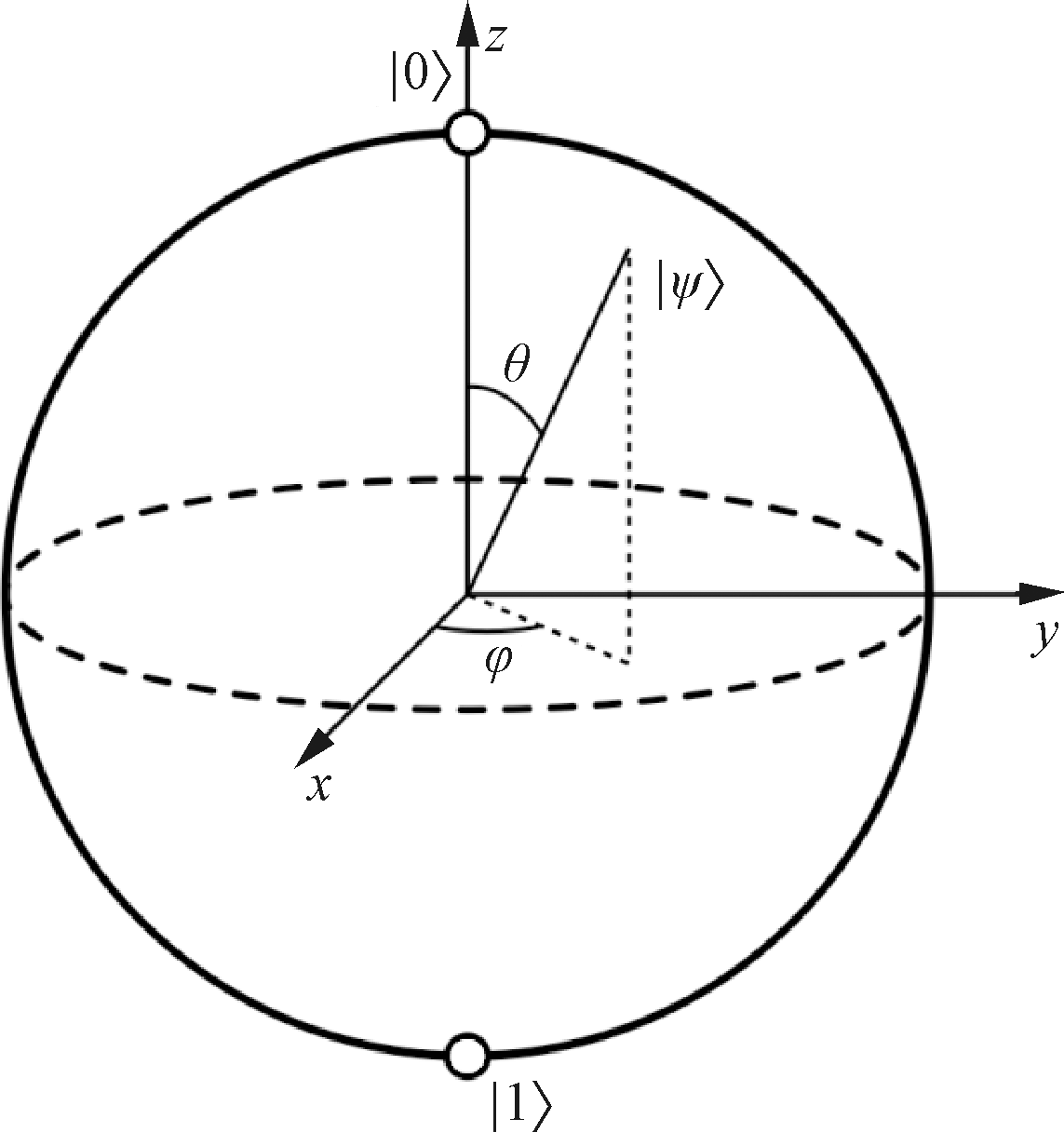
图2 量子比特的Bloch球面表示(来源:https://en.wikipedia.org/wiki/Qubit)
Fig. 2 Bloch sphere representation of a qubit(Source: https://en.wikipedia.org/wiki/Qubit)

图3 中国科学院物理研究所固态量子信息与计算实验室的超导量子计算装置
Fig. 3 Superconducting quantum computing device at Solid State Quantum Information and Quantum Computation Laboratory of the Institute of Physics, Chinese Academy of Sciences

图4 Quafu量子计算云平台网页
Fig. 4 Website of Quafu Quantum Computing Cloud Platform

图5 IBM以量子为中心的超级计算机示意(来源:IBM’s Big Bet on the Quantum-Centric Supercomputer)
Fig. 5 IBM’s quantum-centric supercomputer(Source: IBM’s Big Bet on the Quantum-Centric Supercomputer)
| [1] | Feynman R P. Simulating physics with computers[M]// Feynman and Computation. Boca Raton: CRC Press, 2018: 133-153. |
| [2] | Shor P W. Algorithms for quantum computation: Discrete logarithms and factoring[C]// Proceedings 35th Annual Symposium on Foundations of Computer Science. Piscataway: IEEE Press, 1994: 124-134. |
| [3] | Grover L K. A fast quantum mechanical algorithm for database search[C]// Proceedings of the Twenty-eighth Annual ACM Symposium on Theory of Computing. New York: ACM Press, 1996: 212-219. |
| [4] | Long G L. Grover algorithm with zero theoretical failure rate[J]. Physical Review A, 2001, 64(2): 022307, doi: 10.1103/PhysRevA.64.022307. |
| [5] | Shor P W. Scheme for reducing decoherence in quantum computer memory[J]. Physical Review A, 1995, 52(4): R2493-R2496. |
| [6] | Steane A M. Error correcting codes in quantum theory[J]. Physical Review Letters, 1996, 77(5): 793, doi: 10.1103/PhysRevLett.77.793. |
| [7] | Chuang I L, Gershenfeld N, Kubinec M. Experimental implementation of fast quantum searching[J]. Physical review letters, 1998, 80(15): 3408, doi: 10.1103/PhysRevLett.80.3408. |
| [8] |
Nakamura Y, Pashkin Y A, Tsai J S. Coherent control of macroscopic quantum states in a single-Cooper-pair box[J]. Nature, 1999, 398(6730): 786-788.
DOI |
| [9] | Preskill J. Quantum computing in the NISQ era and beyond[J]. Quantum, 2018, 2: 79, doi: 10.22331/q-2018-08-06-79. |
| [10] |
Arute F, Arya K, Babbush R, et al. Quantum supremacy using a programmable superconducting processor[J]. Nature, 2019, 574(7779): 505-510.
DOI |
| [11] | IBM Unveils Breakthrough 127-Qubit Quantum Processor[EB/OL].(2021-11-16)[2025-06-17]. https://newsroom.ibm.com/2021-11-16-IBM-Unveils-Breakthrough-127-Qubit-Quantum-Processor. |
| [12] | IBM Unveils 400 Qubit-Plus Quantum Processor and Next-Generation IBM Quantum System Two[EB/OL].(2022-11-09)[2025-06-17]. https://newsroom.ibm.com/2022-11-09-IBM-Unveils-400-Qubit-Plus-Quantum-Processor-and-Next-Generation-IBM-Quantum-System-Two. |
| [13] |
Google Quantum AI and Collaborators. Quantum error correction below the surface code threshold[J]. Nature, 2024, 638(8052): 920-926.
DOI |
| [14] | Nielsen M A, Chuang I L. Quantum computation and quantum information[M]. Cambridge: Cambridge University Press, 2010. |
| [15] | Einstein A, Podolsky B, Rosen N. Can quantum-mechanical description of physical reality be considered complete?[J]. Physical Review, 1935, 47: 777, doi: 10.1103/PhysRev.47.777. |
| [16] |
李晓巍, 付祥, 燕飞, 等. 量子计算研究现状与未来发展[J]. 中国工程科学, 2022, 24(4): 133-144.
DOI |
| Li X W, Fu X, Yan F, et al. Research status and future development of quantum computing[J]. Engineering Science in China, 2022, 24(4): 133-144. (in Chinese) | |
| [17] | AbuGhanem M. IBM quantum computers: Evolution, performance, and future directions[J]. The Journal of Supercomputing, 2025, 81(5): 687, doi: 10.1007/s11227-025-07047-7. |
| [18] | Rigetti announces public availability of Ankaa-2 system with a 2.5x performance improvement compared to previous QPUs[EB/OL]. (2024-01-04)[2025-06-18]. https://www.globenewswire.com/news-release/2024/01/04/2804006/0/en/Rigetti-Announces-Public-Availability-of-Ankaa-2-System-with-a-2-5x-Performance-Improvement-Compared-to-Previous-QPUs.html. |
| [19] | 中国信通院. 量子信息技术发展与应用研究报告(2024年)[R/OL]. (2024-12-26)[2025-06-17]. https://www.caict.ac.cn/kxyj/qwfb/bps/202412/P020241226535384440580.pdf. |
| China Academy of Information and Communications Technology. Research report on the development and application of quantum information technology (2024)[R/OL]. (2024-12-26)[2025-06-17]. https://www.caict.ac.cn/kxyj/qwfb/bps/202412/P020241226535384440580.pdf. (in Chinese) | |
| [20] | Quantinuum dominates the quantum landscape:New world-record in quantum volume[EB/OL].(2025-05-12)[2025-06-18]. https://www.quantinuum.com/blog/quantum-volume-milestone. |
| [21] |
PsiQuantum Team. A manufacturable platform for photonic quantum computing[J]. Nature, 2025, 641(8064): 876-883.
DOI |
| [22] |
Madsen L S, Laudenbach F, Askarani M F, et al. Quantum computational advantage with a programmable photonic processor[J]. Nature, 2022, 606(7912): 75-81.
DOI |
| [23] |
Zhong H S, Wang H, Deng Y H, et al. Quantum computational advantage using photons[J]. Science, 2020, 370(6523): 1460-1463.
DOI URL |
| [24] | Zhong H S, Deng Y H, Qin J, et al. Phase-programmable gaussian boson sampling using stimulated squeezed light[J]. Physical Review Letters, 2021, 127(18): 180502, doi: 10.1103/PhysRevLett.127.180502. |
| [25] | 新华网. 550计算量子比特相干光量子计算机在京发布[EB/OL]. (2024-04-19)[2025-06-22]. http://www.bj.xinhuanet.com/20240419/f76bb4b164174adbb7ec19f322b3c8e2/c.html. |
| Xinhuanet. 550 computational qubit coherent optical quantum computer released in Beijing[EB/OL]. (2024-04-19)[2025-06-22]. http://www.bj.xinhuanet.com/20240419/f76bb4b164174adbb7ec19f322b3c8e2/c.html. (in Chinese) | |
| [26] | Quantum startup Atom Computing first to exceed 1,000 qubits[EB/OL]. (2023-10-24)[2025-06-18]. https://atom-computing.com/quantum-startup-atom-computing-first-to-exceed-1000-qubits/. |
| [27] |
Chen C, Bornet G, Bintz M, et al. Continuous symmetry breaking in a two-dimensional Rydberg array[J]. Nature, 2023, 616(7958): 691-695.
DOI |
| [28] | Bornet G, Emperauger G, Chen C, et al. Enhancing a many-body dipolar Rydberg tweezer array with arbitrary local controls[J]. Physical Review Letters, 2024, 132(26): 263601, doi: 10.1103/PhysRevLett.132.263601. |
| [29] |
Bluvstein D, Evered S J, Geim A A, et al. Logical quantum processor based on reconfigurable atom arrays[J]. Nature, 2024, 626(7997): 58-65.
DOI |
| [30] |
Zwanenburg F A, Dzurak A S, Morello A, et al. Silicon quantum electronics[J]. Reviews of Modern Physics, 2013, 85(3): 961-1019.
DOI URL |
| [31] | Microsoft unveils Majorana 1, the world’s first quantum processor powered by topological qubits[EB/OL]. (2025-02-19)[2025-06-19]. https://azure.microsoft.com/en-us/blog/quantum/2025/02/19/microsoft-unveils-majorana-1-the-worlds-first-quantum-processor-powered-by-topological-qubits/. |
| [32] | Ghosh J, Fowler A G, Geller M R. Surface code with decoherence: An analysis of three superconducting architectures[J]. Physical Review A, 2012, 86(6): 062318, doi: 10.1103/PhysRevA.86.062318. |
| [33] | Brun T A. Quantum error correction[DB/OL]. arXiv preprint:1910.03672, 2019. |
| [34] | Chatterjee A, Phalak K, Ghosh S. Quantum error correction for dummies[C]// 2023 IEEE International Conference on Quantum Computing and Engineering (QCE). Piscataway: IEEE Press, 2023, 1: 70-81. |
| [35] | Fowler A G, Mariantoni M, Martinis J M, et al. Surface codes: Towards practical large-scale quantum computation[J]. Physical Review A, 2012, 86(3): 032324, doi: 10.1103/PhysRevA.86.032324. |
| [36] | Bombin H, Martin-Delgado M A. Topological quantum distillation[J]. Physical Review Letters, 2006, 97(18): 180501, doi: 10.1103/PhysRevLett.97.180501. |
| [37] | Breuckmann N P, Eberhardt J N. Quantum low-density parity-check codes[J]. PRX Quantum, 2021, 2(4): 040101, doi: 10.1103/PRXQuantum.2.040101. |
| [38] | Riverlane. The quantum error correction report 2024[R/OL]. (2024-11-19)[2025-06-21]. https://www.riverlane.com/quantum-error-correction-report-2024. |
| [39] | 中国信通院. 量子计算发展态势研究报告(2024年)[R/OL]. (2024-09-25)[2025-06-18]. https://www.caict.ac.cn/kxyj/qwfb/ztbg/202409/P020240925556609114480.pdf. |
| China Academy of Information and Communications Technology. Research report on the development trend of quantum computing (2024)[R/OL]. (2024-09-25)[2025-06-18]. https://www.caict.ac.cn/kxyj/qwfb/ztbg/202409/P020240925556609114480.pdf. (in Chinese) | |
| [40] | Nguyen H T, Krishnan P, Krishnaswamy D, et al. Quantum cloud computing:A review, open problems, and future directions[DB/OL]. arXiv preprint:2404.11420, 2024. |
| [41] | Javadi-Abhari A, Treinish M, Krsulich K, et al. Quantum computing with Qiskit[DB/OL]. arXiv preprint:2405.08810, 2024. |
| [42] | Alexander T, Kanazawa N, Egger D J, et al. Qiskit pulse: Programming quantum computers through the cloud with pulses[J]. Quantum Science and Technology, 2020, 5(4): 044006, doi: 10.1088/2058-9565/aba404. |
| [43] | Google Quantum AI. Cirq—An open source framework for programming quantum computers[EB/OL]. [2025-06-22]. https://quantumai.google/cirq. |
| [44] | Amazon AWS. Amazon braket getting started[EB/OL]. [2025-06-22]. https://aws.amazon.com/braket/getting-started/. |
| [45] | 中国电信. 天衍量子计算云平台[EB/OL]. [2025-06-21]. https://qc.zdxlz.com/home?lang=zh. |
| China Telecom. Tianyan quantum computing cloud platform[EB/OL]. [2025-06-21]. https://qc.zdxlz.com/home?lang=zh. (in Chinese) | |
| [46] | Pyquafu量子计算软件开发工具[EB/OL]. [2025-06-21]. https://github.com/ScQ-Cloud/pyquafu. |
| Pyquafu quantum computing software development tools[EB/OL]. [2025-06-21]. https://github.com/ScQ-Cloud/pyquafu. (in Chinese) | |
| [47] | 本源量子计算云平台[EB/OL]. [2025-06-21]. https://qcloud.originqc.com.cn/zh/home. |
| Source quantum computing cloud platform[EB/OL]. [2025-06-21]. https://qcloud.originqc.com.cn/zh/home. (in Chinese) | |
| [48] | 中国移动. 五岳量子计算云平台[EB/OL].[2025-06-21]. https://ecloud.10086.cn/portal/product/WYQCLOUD. |
| China Mobile. Wuyue quantum computing cloud platform[EB/OL]. [2025-06-21]. https://ecloud.10086.cn/portal/product/WYQCLOUD. (in Chinese) | |
| [49] | Lubinski T, Granade C, Anderson A, et al. Advancing hybrid quantum-classical computation with real-time execution[J]. Frontiers in Physics, 2022, 10: 940293, doi: 10.3389/fphy.2022.940293. |
| [50] | Mircosoft Azure Quantum. Get started with sessions[EB/OL]. (2024-10-24)[2025-06-21]. https://learn.microsoft.com/en-us/azure/quantum/hybrid-computing-interactive?tabs=tabid-iqsharp. |
| [51] | Mohseni M, Scherer A, Johnson K G, et al. How to build a quantum supercomputer:Scaling challenges and opportunities[DB/OL]. arXiv preprint:2411.10406, 2024. |
| [52] | Main D, Drmota P, Nadlinger D P, et al. Distributed quantum computing across an optical network link[J]. Nature, 2025, 638(8050):N383-388. |
| [53] | 王升斌, 窦猛汉, 吴玉椿, 等. 分布式量子计算研究进展[J]. 量子电子学报, 2024, 41(1): 1-25. |
| Wang S B, Dou M H, Wu Y C, et al. Research progress on distributed quantum computing[J]. Chinese Journal of Quantum Electronics, 2024, 41(1): 1-25. (in Chinese) | |
| [54] | Oak Ridge National Laboratory Leadership Computing Facility. Quantum Computing User Program (QCUP) access[EB/OL]. [2025-06-22]. https://docs.olcf.ornl.gov/quantum/quantum_access.html. |
| [55] | Shehata A, Groszkowski P, Naughton T, et al. Building a software stack for quantum-hpc integration[DB/OL]. arXiv preprint:2503.01787, 2025. |
| [56] | IBM. IBM and RIKEN unveil first IBM quantum system two outside of the U.S.[EB/OL]. (2025-06-23)[2025-06-25]. https://newsroom.ibm.com/2025-06-23-ibm-and-riken-unveil-first-ibm-quantum-system-two-outside-of-the-u-s. |
| [57] | EuroHPC J U. High Performance Computer-Quantum Simulator (HPCQS) hybrid[EB/OL]. [2025-06-22]. https://www.hpcqs.eu. |
| [58] | EuroHPC J U. Boosting Europe’s quantum computing infrastructure[EB/OL]. [2025-06-22]. https://eurohpc-ju.europa.eu/boosting-europes-quantum-computing-infrastructure-2024-12-02_en. |
| [59] | 中国新闻网. 中国量超融合先进计算平台正式发布上线[EB/OL].(2023-09-15)[2025-06-22]. http://www.chinanews.com.cn/cj/2023/09-15/10078448.shtml. |
| China News Service. China quantum-supercomputing converged advanced computing platform officially released and launched[EB/OL]. (2023-09-15) [2025-06-22]. http://www.chinanews.com.cn/cj/2023/09-15/10078448.shtml. (in Chinese) | |
| [60] | 北京量子信息科学研究院. Quafu量子计算云平台入驻国家超算互联网[EB/OL].(2024-04-03)[2025-06-22]. https://www.baqis.ac.cn/news/detail/?cid=2014. |
| Beijing Quantum Information Science Research Institute. Quafu quantum computing cloud platform joins the national supercomputing internet[EB/OL]. (2024-04-03)[2025-06-22]. https://www.baqis.ac.cn/news/detail/?cid=2014. (in Chinese) | |
| [61] | 国盾量子. 合肥超量融合计算中心巢湖明月将建量子计算机[EB/OL]. (2024-04-02)[2025-06-22]. |
| QuantumCTek Co., Ltd. Hefei quantum-supercomputing converged computing center Chaohu Mingyue to build quantum computer![EB/OL]. (2024-04-02)[2025-06-22]. https://www.quantum-info.com/News/qy/2024/2024/0724/803.html. (in Chinese) |
| [1] | 李爱仙, 范琼, 刘静, 刘玉龙, 汪海锋, 韩清珍, 任维娟. 全球量子计算技术研究进展与发展建议[J]. 前瞻科技, 2025, 4(4): 11-20. |
| [2] | 马剑宇, 吴宇恺, 张弛, 梅全鑫, 连文倩, 蔡明磊, 赵文定, 毛志超, 姚麟, 杨蒿翔, 段路明. 离子量子计算及其规模化研究进展和建议[J]. 前瞻科技, 2025, 4(4): 21-33. |
| [3] | 郭富强, 邵晓强. 中性原子量子计算研究进展[J]. 前瞻科技, 2025, 4(4): 34-45. |
| [4] | 龙桂鲁, 魏世杰, 高攀, 李行, 邢同昊, 曾进峰, 张江. 量子算法研究现状及战略发展路线图[J]. 前瞻科技, 2025, 4(4): 46-63. |
| [5] | 任维娟, 刘静, 范琼, 金贻荣, 韩清珍, 汪海锋, 李爱仙. 量子计算上下游产业链发展现状与建议[J]. 前瞻科技, 2025, 4(4): 83-91. |
| 阅读次数 | ||||||
|
全文 |
|
|||||
|
摘要 |
|
|||||